Welcome to our website !
The SacrificeIf Sugata Mitra thinks of himself as basically a humble scientist investigating the benefits of educational technology, he is deceiving himself. His appeal – the crucial factor explaining his rise to fame – lies not in the scientific rigor of his work (which people like Payal Arora and Donald Clark have criticised) but in the tweet-length myths that he has been helping to spin. In a previous post we looked at the Sugata Mitra myth of the end of empire. Another myth is the idea that knowing is now becoming obsolete. In his February 2013 TED talk he said this:
Could it be that we won’t need to go to school at all? Could it be that, at the point in time when you need to know something, you can find it out in two minutes? Could it be – a devastating question, a question that was framed for me by Nicholas Negroponte – could it be that we are heading towards a future where knowing is obsolete? But that’s terrible. We are homo sapiens. Knowing, that’s what distinguishes us from the apes. But look at it this way. It took nature 100 million years to make the ape stand up and become homo sapiens. It took us only 10,000 to make knowing obsolete. What an achievement that is.
Now, Sugata Mitra can’t actually mean that there will be no knowing. Mitra is not against learning, and anyone who is still an advocate of learning must be advocating some sort of knowing, however vestigial. In Mitra’s case, the learning he advocates is to become more and more child-driven, with children finding their own sources of information online to answer questions set by the teacher, and it would be a terrible failing if the children working hard in their self-organising learning environments (SOLEs) didn’t know more at the end of a project than they did at the beginning.
If we think about what is supposed to happen in the SOLEs, we see that what is really obsolete for Mitra is an older idea of the curriculum as a list of particular things that students ought to become familiar with. Hence, in the SOLEs the students are learning, and presumably coming to know more, but there is no concern about what exactly the students are learning. The teachers are to set questions, and it seems that these could be chosen pretty much at random as long as they are not too difficult for the children in question. Mitra suggests, for instance, asking 8- to 12-year-olds if someone could kill a goat by staring at it. The children search online for possible answers for 45 minutes or so, and work in groups to decide which is best. Just as the questions don’t really matter, neither do the answers (and the teacher is not supposed to express any interest in the children arriving at one answer rather than another).
So in the epoch beyond that of the Homo Sapiens knowing will still happen, but the emphasis will shift so that knowing comes to be less important than the business of finding and processing information. If we look at a society and see that no one knows how vulnerable goats are to an intense human gaze, it doesn’t matter as long as we see that the goat herders amongst them are able to find the answer online when they need to.
What this implies for education is a sort of pedagogic formalism: it is enough for the children to know how to work out the answers; it doesn’t matter in the slightest if they don’t know what any particular answer is.
Part of the reason for taking this approach to knowledge concerns technology. Mitra’s favourite example is the calculator. Why force children to learn multiplication tables when they can find the answers with their calculators? Of course, there is still a great deal that students who are interested in maths will need to know (and there is no indication of that becoming obsolete) but large chunks of the old curriculum that caused so much pain to young children can now (according to Mitra) be dropped because of the new tech. And what the calculator does for maths, the internet does for many other parts of the old curriculum. Mitra has said quite bluntly: When the knowledge exists online, why force children to commit it to memory?
The technology may make this sort of approach seem more feasible, but what is supposed to make it seem reasonable is Mitra’s perception of pedagogic priorities, according to which the thing that really matters in education is the liberation of children. Education must become child-driven. Now, many teachers committed to an older child-centred education also wanted their learners to become autonomous, but there was a clear perception that autonomy could only be achieved after a period of heteronomy, with children needing the pedagogic care of their Socratic teachers in order to achieve their full potential. Mitra’s idea of a child-driven education assumes that the autonomy is already there, and, ideally, we just need to clear a space for the child, give it a laptop and an internet connection, and it will educate itself, with the only human assistance coming from an encouraging mentor giving an occasional pat on the back. Hence, in addition to a pedagogic formalism, we also have a pedagogic libertarianism (that could also be called a pedagogic anarchism).
To put the contrast in other words: A child-centred pedagogy aimed at autonomy, but only after the child had come to accept the weight of society – a weight felt first in the organised life of the school. The pedagogy of a child-driven education, by contrast, toys with the idea of the obsolescence of school, with children learning online, pursuing their own interests at their own pace, assisted (as gently as possible) by encouraging mediators, either real or virtual. The dream is of an education in which society appears to the children to be weightless, where nothing seems to limit or challenge the child’s instinctive life. If Milan Kundera had described this pedagogy, he might have highlighted the wonderful lightness of such a digitally enhanced education conducted in an acultural and apparently timeless nowhere land, supervised by a handful of adults who are trying to make themselves invisible.
Mitra has captured the imagination of a fair number of online teachers, who are inspired by the idea of a child-driven education in which the older idea of the curriculum can be ditched, with teachers stepping to the side, keeping quiet about their expertise and repressing the old belief that the children might be better off knowing certain things and confronting certain things that they might instinctively avoid or ignore. However, there are reasons for remaining a little sceptical. One cluster of reasons has to do with the notion of knowledge that Mitra is taking for granted. Below we try to call that notion into question by coming at it from two directions: one from the self, and another from society.

Knowledge and the self

As a brief semi-philosophical prelude, let us draw a contrast with Descartes. Arguably, the modern intellectual world begins with the Cartesian proposition, “I think, therefore I am.” But that is where Descartes begins, not where he ends. The next step is crucial because the whole Cartesian project would collapse if thinking couldn’t become knowing, and Descartes is desperate to achieve some certainty that what he thinks about the world can count as knowledge. The self would be lost if it did not have a world that it could be sure of. On this account, what is most essential to us is our ability to know the world for ourselves (as opposed to taking things on trust because they are written in the Holy Book or Wikipedia). Mitra’s idea that we embrace the obsolescence of human knowing insofar as the knowledge is now safely stored online would sound to Descartes like the terrible suggestion that we cast ourselves adrift on some dark turbulent river going God knows where. We would be losing the integrity of the self, and be falling back to an older, darker state like the one where we allowed the Inquisition to do whatever it deemed fit. Mitra acknowledges this concern in his comment about Homo Sapiens, but he says nothing to persuade us that it is wrong.
Perhaps (in a somewhat Cartesian way) we need to establish for ourselves whether the obsolescence of knowledge would lead to liberation or dissolution – whether, in other words, the knowing that Descartes insisted on is actually an encumbrance that we are better off without now that society no longer needs to rely on human beings as the main store of knowledge. Mitra’s example of the multiplication tables (that the calculator spares us from having to learn) gives the idea an apparent veracity, but can we draw the conclusion that the less we need to know, the better off we are?
As a thought experiment, let’s imagine going for a walk in the hills. Sugata Mitra will be coming with us, and without a doubt he will be clutching his GPS. He will see us struggling to learn the path through the dense forest unaided by the new technology, and he will ask: Why bother when you can rely on a GPS? Isn’t it as pointless as forcing your young child to learn her multiplication tables?
No, it is not. What Sugata Mitra with his GPS misses is the satisfaction of slowly coming to know the forest and the hills like the back of your hand – an idiom that hints at a deeper connection between the hiker who knows and the hills that are known – a connection less likely to be felt by those who have to keep one eye on a flickering screen
There is a deeper significance in getting to know the forest. There is nothing comparable in knowing how to use a GPS. For those of us who hike low-tech, there is an example here of a form of knowing that the knower would not want to see become obsolete – that the knower would not want to be liberated from.
If we turn from the forest back to the multiplication tables, we might wonder if Mitra was being fair in characterising them as all pain and no gain. Is it not possible that some of the children who learn their tables experience a satisfaction that is not entirely unlike that of the low-tech hiker who comes to know the forest like the back of his hand? After the painful task of learning their multiplication tables, does it not become possible for children to feel a richer sense of themselves and their abilities and to marvel at the new world of number that they have discovered? Is there no such satisfaction? If there is, do we not have a reason for wanting to save what Mitra would gladly consign to the dustbin of history?
And what of foreign languages? According to one reported conversation, Sugata Mitra has toyed with the following question: “Is it necessary to learn new languages at all? Maybe machines will translate.” Again, there is room to doubt whether people are actually better off not knowing a foreign language. Is it so?
No, it is not. Motivated learners of a foreign language are likely to acquire an expanded sense of themselves as they experience their cultural horizons broadening and as they gain a new perspective on the culture they were born into. The tech that Mitra looks forward to would enable children to communicate effortlessly with foreigners, but they would be deprived the deeper satisfactions to be had through actually knowing the foreign language, and their selves – untouched by the foreign language – would remain unbroadened.
Now, let’s use our foreign language skills to take a trip to Delphi. One of the bizarre consequences of the idea that Sugata Mitra is toying with is that although the children are supposed to love finding answers to the teacher’s questions, they are not supposed to really need to know anything beyond the technicalities of how to use the calculator, the touch screen device, the internet, the GPS, the automatic translation machine, etc., etc. There is a perception of children as brimming with curiosity, which today might be directed to the question of why the hand has five fingers, and tomorrow to the question of whether a goat can be killed by staring at it. Beyond that there is no perception of the students really needing to know anything. Is that the case?
Outside the Temple of Apollo in Delphi the ancient Greeks etched an inscription. It didn’t urge the Greeks to develop their information-processing skills. Nor did it urge them to build something that would spare people the labour of cognition. No, the inscription urged them to know themselves. Did the low-tech Greeks grasp something that remains valid? Is education at its best and in its broadest sense not a matter of coming to know ourselves, and does this not involve knowing the world to which we belong? Do the children not need to move towards a Delphic knowledge of themselves and their world, or is it enough that they are continually tossed random questions so that their innate curiosity has something to play with?
In an earlier post on the need for education we quoted Camille Paglia giving a lovely description of that Delphic need in students. After years of teaching college students in America she felt that many reminded her of a scene from the Kubrick movie “2001 A Space Odyssey”, in which one of the astronauts has his lifeline cut and spins off into space. Her young students appeared to be lost – unable to make sense of the world and their place in it. Paglia saw a need there for the students to find a framework of meaning in terms of which things would either begin to make sense or with which the perceived lack of sense would somehow become understandable.
Is this Delphic imperative not alive in all of us who still find occasions of sufficient duration to think, assuming there are still a few fertile gaps in a life filled with wall-to-wall distractions?
For Paglia there is no question that the students have a vital need to know – not the sort of knowledge that has a merely instrumental value, but one that is integral to their very being – a knowledge whose obsolescence could only be achieved by something amounting to an act of amputation.

Knowing and the vision of society

To come at the problem of knowledge from the opposite direction, there is the question of the vision of society that we are to promote. Central to that is the issue of social cohesion. What will hold society together? Let’s suggest two sorts of answers to this question: Either society is held together by an understanding (a knowledge) of itself, or it is held together by something else. The latter might involve supplementing the inertia of habit with policies like ensuring that all citizens become property owners and share-holders who are also in debt to the banks and all have pension funds invested in the economy so that their private self-interests come into perfect alignment with the technocratically tweaked macro-economic interests. This is the sort of approach Sugata Mitra would have to support if he is serious about the obsolescence of knowledge.
Mitra spins the obsolescence of knowledge as a great plus, but when we move through a society that relies on economic carrots and sticks to keep the labouring mules doing their socially necessary work, do we see a great leap forward in the history of civilisation? Recalling our personal entry into such a society, what we experienced was not the thrill of being part of some inspiring historical movement, but rather horror at our own ignorance.
We found ourselves at the age of 18 in the UK queuing up to vote without having any idea about basic things like why the UK has two houses of parliament, why democracy and monarchy are considered compatible, why the UK does not have a constitution, why representative democracy is better than direct democracy, why there must be no democracy in the workplace, why powers were being transferred from the local authorities to central government, why the teachers deserved to lose their autonomy regarding the curriculum, etc., etc. We could solve any number of differential equations and we had an intimate knowledge of things like Doppler effect, photosynthesis and the anatomy of the locust, but we knew virtually nothing about the political world we found ourselves in. We were citizens (or were we subjects?), but we had absolutely no idea what that meant. Outside school a discussion started about what it meant to be British, and the idea circulated that it all hinged on which cricket team you supported. Beyond that we didn’t have a clue. Britain’s political leaders were refusing closer ties with Europe. Why? What was Europe? Why should it be resisted? Were we not Europeans? Was there not a European heritage that we should embrace? We had no idea.
In addition to the felt need to belong to a society that understands itself and relies upon its self-understanding, there is the question of how well a society will rise to the challenges facing it if it is not organised to shore up and pass on its collective wisdom. Our society faces a series of massive challenges: demographic, economic and environmental. The current assumption is that the narrowest form of self-interest will pull us through, as long as governments set in place the right carrots and sticks. But will it?
Arguably, society needs to be re-established on a different footing. For all his pseudo-radicalism, Sugata Mitra’s view of education and knowledge leaves him supporting the status quo. A society full of SOLE graduates pursing their own specialised cognitive interests would be worse than the one we have now insofar as there would be no attempt to collectively learn from the past and organise ourselves better to meet the challenges of the future. Mitra’s approach rules out the collective organisation of education – something we would need if, for instance, we decided that students in the future ought to know the causes of the recent economic meltdown in order to avoid a repetition in the future, and that they ought to know about the contradiction between an economic system that demands infinite growth and an environment with finite natural resources. That would give us a curriculum with particular topics that students ought to be studying and developing their own ideas about, but that would be anathema for Mitra.
In brief comments he has made, Sugata Mitra sees the problem. When working with pupils in the north-east of England he has remarked, for instance, about the poverty of their dreams – dreams shaped by our celebrity culture. Some of his most enthusiastic comments following SOLE experiments in places like Gateshead were about how some of the children’s dreams were becoming more thoughtful and intelligent. Although Mitra has said again and again that progress requires the abolition of schools, his experience actually implies the opposite: the pressing need for schools that can generate a more thoughtful and intelligent culture – a process that involves not just liberating children, but also challenging them. Good teachers recognise that this involves promoting knowledge – a knowledge that is both the self-knowledge of the children and their knowledge of the culture to which they belong – a knowledge that is, at the same time, critique.
The issue here is extremely thorny for those of us living in liberal societies, because to push for a more thoughtful culture would be to lock horns with the liberal ban on a rich notion of the public good. According to the status quo, the notions of the good that are promoted in public (political) life have to be kept as thin as possible in order to maximise the freedom of individuals to pursue their dreams of fame, fortune and power. Although Mitra occasionally sees the need for the promotion of a more thoughtful culture, he ends up ruling it out because of his commitment to an unreflective notion of individual liberty. And his idea of knowledge as excess baggage also undermines any real concern for culture.
In effect, the way he frames his self-organised learning environments turns them into ultra-liberal training grounds. Just as the liberal government is (in theory) supposed to bracket any claim to a rich knowledge of the public good, Mitra insists his teachers express no opinion about which of his student’s answers comes closer to the truth. Just as the liberal political myth implies that the past is irrelevant as is the future (beyond the maturation of one’s personal pension fund), the SOLE creates the impression for the students that there is no weighty heritage that they ought to learn how to shoulder, and there is no prior set of collective priorities and common challenges that they ought to recognise and appreciate.
A further ultra-liberal feature of this set-up is Mitra’s assumption that knowledge is all about the facts of the matter – the sort of thing that the children can find on Wikipedia. Our dumbed-down culture retains a great respect for the facts and for the experts who have privileged access to them, at the same time as significant parts of the population retain a private fascination with mumbo jumbo. What the culture lacks is a more intelligent approach to our feelings (which is one way of framing the problem of the good). If we really want to challenge the dumbing down of culture, we need to do more work with the emotional lives of children (which actually has less to do with a narrow notion of feelings and more to do with broadening their sense of themselves and their appreciation of the world around them). But Mitra’s notion of education-as-fact-finding-and-information-processing excludes that education of intelligent feeling, and so he thoughtlessly affirms the familiar split between unfeeling truth of the technocrat and the thoughtless enthusiasm of the public queuing up for the next round of X-Factor auditions.
So – in closing – when Sugata Mitra spins the myth of the obsolescence of knowledge, he assumes the worst possible conception of knowledge, forgetting both the deep personal need to know, and the historical need for society to develop a better understanding of itself – an understanding that is shared, not lying dormant on a hard-drive or alive only in the minds of a handful of experts. The question for us is whether Mitra’s vision of an Information Age united not by knowledge but by private self-interest and a love of technology represents a great leap forward for civilisation or a step towards dissolution. Do we not feel both a personal and a social imperative to find a new significance in our collective knowing, rather than affirming its obsolescence as we roll further towards a technocratic society marked not by a shared understanding, but by a shared despair at the possibility of understanding?

Gavin Dudeney Nicolas Rubashov

We have been re-reading Darkness at Noon, by Arthur Koestler, and on page 136 the central character, Rubashov, makes some interesting remarks about the implications of technological development for education. A stark contrast immediately came to mind between this perception of the problems posed by technological change and the very different perception voiced by the edtech discourse that trumpets the virtues of the digital revolution. In this post we simply want to sketch that contrast.
Because Rubashov is a particular (if fictional) individual, we want an individual representative of the edtech community with which to contrast his position. We have chosen Gavin Dudeney, an edtech edupreneur.
We begin with a question.
What challenges does the so-called “digital revolution” pose for education?
The main challenge perceived by the edtechers is simply that of getting both teachers and students up to speed with the new tools. This is evident in Dudeney’s British Council talk on digital literacy, where the primary concern is with the ability of teachers and students to use the high-tech kit.
There is a secondary challenge that Dudeney mentions. It is not enough for children to know how to use the new tools. They must develop the habit of giving priority to the digital whenever there is the option of doing so. There is a commandment here, which Dudeney avoids spelling out, but is nevertheless plain to see: If something can be done with the new tech, then it must be done with it. Through long habituation, beginning at the youngest possible age, that principle must become second nature for the learner. To test whether someone is digitally literate, Dudeney makes clear, would not involve giving them MCQs relating to the technicalities of the internet, rather it would involve asking them, for instance, what they touch first when they wake up. If they touch their iTotem mobile device, then this is one sure sign that they are digitally literate (and can, consequently, continue safe in the knowledge that they will not be ridiculed for being out of step with History, which has now entered the New Era – an era that Dudeneydates, in suitably corporate fashion, from the (immaculate?) birth of Google).
How does this edtech approach to the question compare to that of Rubashov? Admittedly, the character of Rubashov belongs to the pre-digital age, and the words we will quote below refer to the height of the industrial revolution in the Soviet Union during the 1930s. However, he is talking about technological progress in general, and what he has to say applies just as well to digital technology.
As you may recall, in Darkness at Noon Nicolas Rubashov is imprisoned, accused of counter-revolutionary activities, and while he is still hopeful of being able to argue his case in court he begins to reflect upon why his aspirations for a more democratic society could not be fulfilled at that point in history. As he sees it, there is a crucial link between democracy and the level of technological development. He sees a general principle:
“A people’s capacity to govern itself democratically is proportionate to the degree of its understanding of the structure and functioning of the whole social body.”
This is immediately followed by an explanation:
“Every technical improvement adds to the complexity of the economic apparatus, causes the appearance of new factors and combinations which the masses cannot penetrate for a time. Every jump of technical progress leaves the relative intellectual development of the masses a step behind, and thus causes a fall in their political maturity. It takes sometimes tens of years, sometimes generations, for a people’s level of understanding gradually to adapt itself to the changed state of affairs, until it has recovered the same capacity for self-government, as it had already possessed at a lower stage of civilization.”
He gives a number of examples:
“The discovery of the mechanical loom, for example, sets the masses back into a state of relative immaturity…
“The invention of the steam engine started a period of rapid objective progress, and, consequently, of equally rapid subjective political regression.” (136)
To highlight the contrast here, let’s stick for a moment with the example of the steam engine. If we were to take Gavin Dudeney and the other edtechers back to the early steam age, they would be giving talks at the British Council arguing that the great challenge in education is teaching people how to read the timetable, pick the best route, turn up at the right platform on time, then get off at the right station – the steam equivalent of the sort of how-to knowledge that constitutes the edtecher’s sole interest.
Rubashov knows better. The railways added a new level of complexity to the world that went way beyond the technicalities of getting on the right train and getting off at the right station. Even after becoming competent train-travellers, people faced a formidable new task: understanding this more complex world.
For Rubashov the question of understanding is not an idle one of merely academic significance, but rather one of huge political significance for someone who believes in democracy, since people cannot hope to govern their world responsibly if they cannot understand it. What is disturbing about the edtech approach to technology is its blindness to this need for people to understand the complexity of the world they live in, with the outrageous implication that everything is fine as long as everyone is tapping away at touch screens that carry the logo of their favourite brand.
With the “digital revolution” the world takes a step up to an even higher level of complexity. The more important forms of complexity here are not the bewildering mechanics of the core and the periphery of the internet. Of more importance for those of us still concerned about political maturity is the complexity of the effects of that technology on diverse aspects of our social world: new forms of financial trading, new forms of surveillance, new distributions of power, new patterns of family life, new perceptions of time and space, new perceptions of ourselves and our world, and so on, and so on. Although the STEM-loving edtechers will tend to emphasize the technical know-how involved in things like coding and app-designing, the greater challenge in education is helping people understand the changed social and psychological worlds that live through us. We need to help students stand back from those worlds, scrutinise them, see them from new perspectives and begin to understand them, as opposed to keeping the students immersed in something whose deeper structure they are unaware of and whose history they are unable to narrate.
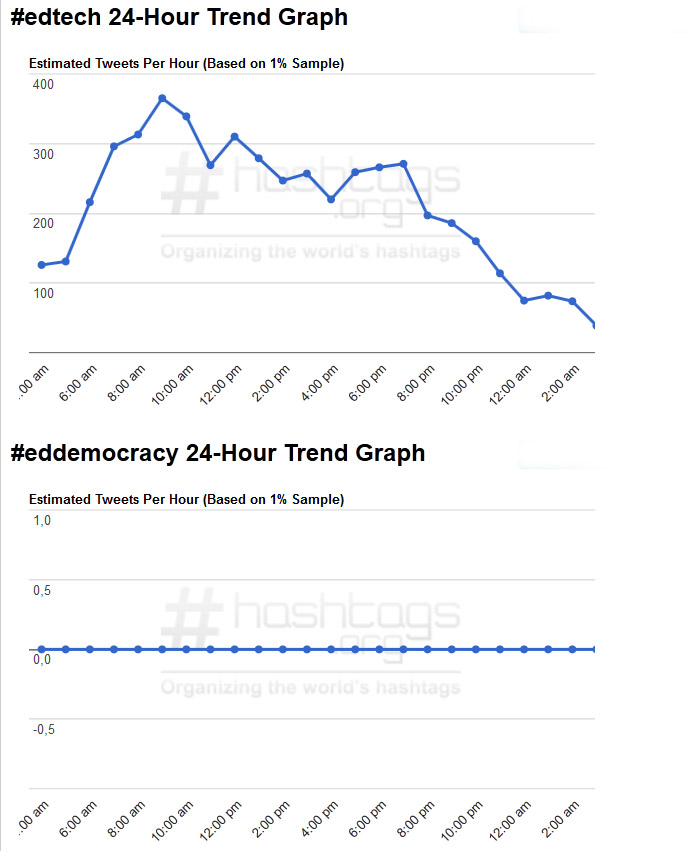
Caveat: To follow Rubashov here and agree that this is the greater challenge in education, we need to care about a more vital democracy and the political maturity required for it. Unfortunately this care doesn’t seem to be shared by many of those who are banging the drums for the Digital Revolution. Just have a look at the frequency with which the relevant hastags are used on Twitter. The use of the #edtech hashtag peaks now at over 300 tweets per hour. Tweets using #eddemocracy average about two or three per year.
edtech twitter
Technology and labourAt no time in history have people been so obsessed with their tools. The edtech discourse turns discussions of education into discussions about the new educational tools, and the discourse of the digital revolution assumes that the latest wave of tools (silicon chips, fibre optics, the hypertext transfer protocol, etc., etc.) are ushering in a new era for humanity. This obsession with tools implies a view of the essence of our human being: the view that we are above all tool-using animals.
A quick contrast: Classical Greek civilisation was built using tools and advanced technical know-how, but even a quick flick through the works of someone like Aristotle reveals that all the emphasis is on the civilisation they built, not on the tools with which they built it. For us, the word “civilisation” seems like the remnant of a dead language, but talk of tools is just about the liveliest talk there is. We now seem to think of ourselves primarily in terms of the tools we use and not the civilisation we belong to.
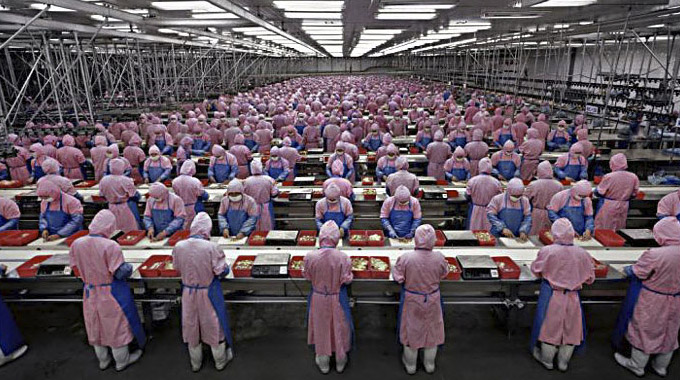
This distinctively modern view of tools and their essential relation to our human being came to the surface briefly in a talk given by Gavin Dudeney about digital technology and education. 24 minutes into his talk he addressed the question of why teachers should make full use of the new tech in their lessons. To persuade the possibly wary educationalists the first thing Dudeney did was project the following image onto the screen behind him.
Digital homo faber
Dudeney said nothing about the image itself, but chose to make some comments instead about developments in Spain and India, highlighting how countries are moving forward by digitally retooling and devoting more of their economies to things like data-processing. However, although the image considered on its own is ambivalent, the message in the context of Dudeney’s talk is clear: This is progress; the advance of technology is the advance of humanity (and no educationalist in their right mind would be against progress).
First of all, it is worth noting that the edtech discourse, which in other settings tries to spin itself as revolutionary, is really an utterly conservative reaffirmation of the bad old narrative developed during the Enlightenment – a narrative about humanity ascending as it develops the technological means to harness the powers of nature. The narrative has its roots in the sort of hopes expressed by Francis Bacon back in the 1630s – hopes about the new science of natural causes being a source of tremendous new powers. In investigating the causes of natural phenomena we will learn how to produce the effects ourselves, gradually putting us in command of nature so that we can build a New Atlantis.
Francis Bacon technology hopes
Hiroshima in the dialectic of the Enlightenment
Back in the seventeenth and eighteenth centuries it was excusable for people to have a naïve optimism about the progress that would be made possible by the new science and its technological applications – a naïve optimism not only about material plenty but also about the spread of a global, scientifically-based civilisation accompanied by universal peace. There is no excuse for such naivety after the world wars of the 20th century and after the unscrupulous development of the murderous tools in relation to which Robert Oppenheimer said “Now I am become Death, the destroyer of worlds.”
To engage critically with the image of man as essentially a tool-using animal involves taking a closer look at this Enlightenment discourse that first construed technology as the most progressive force in history.
One of the most common criticisms of the Enlightenment project is this: Man with his new tools was supposed to dominate nature, but, in the process of reorganising society to that end, individual men find that they have become slaves to a social order that has the same relentless and merciless character as the natural order they were supposed to have dominated. Georg Simmel in The Philosophy of Money (p483) sums this up nicely: “the machine, which was supposed to relieve man from his slave labour in relation to nature, has itself forced him to become a slave to it.” (Of course people like Sugata Mitra have tried to argue that digital technology is different in that it liberates individuals instead of enslaving them, but he has yet to convince the employees of Foxconn or the shop assistants selling his favourite tablet devices or the unemployed who are able to experience the true meaning of liberation in a society where the most important form of public life is economically productive labour.)
Digital labour
This standard criticism of the Enlightenment vision of the rise of the tool-using man is unsatisfactory insofar as it leaves us hankering after a form of domination that has proven to be self-defeating. We are left with the feeling that we are trapped. There is no way out.
A line of criticism that avoids this pitfall is the one developed by Hannah Arendt in The Human Condition – a book that devotes a lot of attention to the rise of the tool-using man in the modern world – a human type also known as homo faber.
As Arendt argues, in the early modern period homo faber came to be the highest human type, ousting classical notions of the greater excellence of the political life and medieval notions of the supremacy of the contemplative life. It can even be argued that the new science of natural causes was framed according to the needs of homo faber: the study of natural causes is the study of how to produce and reproduce the things of nature in the laboratory. Classical philosophy concentrated on the question of what (What is life? What is beauty? What is the highest good?), whereas the modern natural philosophy that became modern science concentrates more on questions of how (how inanimate elements combine to form a living organism, for instance). So, in a sense, the modern scientist, who might appear to be held in high regard, is actually a menial figure carrying the intellectual bags of homo faber. It is homo faber who is going to effect the domination of nature dreamed of by people like Francis Bacon. It is his success that is to legitimate the entire modern project.
As Hannah Arendt argues in The Human Condition (p312) what is curious about homo faber is not that he comes to ascendance in the modern world but that he fails to assert himself in an epoch that, at first sight, seems to be organised according to his dictates. Arendt’s analysis highlights a deeper problem beneath the more obvious dialectic of the Enlightenment (in which the would-be master becomes the slave). Figuratively, we might sum up the problem in this way: At exactly the point at which homo faber is placed in the driving seat of history, something happens that cuts the cables of the headlights, and he is left driving in the dark.
To appreciate that problem first we need to clarify who homo faber is.
Homo faber, at his best, is the builder of the world that we collectively inhabit and that we can regard as our home on Earth. The form of knowledge that is distinctive to homo faber is the knowledge of how to build the things of the world. Also characteristic of homo faber is an instrumental approach to the natural world: seeing it as a source of means that can be put to work to achieve the end of the building process. The tree is seen as timber; the sun is solar energy; the sand on the beach is a source of silicon, etc., etc.
The know-how and the instrumental reasoning of homo faber are necessary but not sufficient for the activity of building a world. Homo faber needs to draw upon a different kind of knowledge – a knowledge of what we should be building – a knowledge of the values in terms of which we can judge the goodness of the things of our world. Homo faber knows how to build, but he does not know what to build.
Given this image of homo faber at his best, how is homo faber fairing now? To some extent he is alive and well. The DIY business in places like the UK is flourishing. Every weekend tool-using men are doing things like insulating their lofts or adding a conservatory to the back of their houses. In the private sphere millions of people are happily using their favourite tools to build their own little worlds. It makes little difference if the tools are digital or pre-digital. People online are equally busy using the new tools to build little virtual worlds as the introductory video at the Second Life website makes clear:
Homo faber builds a second world
This is what the modern homo faber does in his spare time in the domestic sphere. The more important issue concerns how homo faber is faring in the public sphere. If homo faber can really assert himself as the ultimate historical force, it will be in the public sphere. So, how well is homo faber doing there?
Here is where the blindness of the modern homo faber really becomes apparent. Although at home, the DIY amateur knows what he should be building, in the public world of work things are very different. Let’s use an example from our own experience. Homo faber signs a contract with a large international publishing company to write a collection of educational materials. He wonders: “What should I write? Each book of educational materials will promote a certain kind of approach to education. Which kind of approach should we be promoting?” He tries to raise the issue with his employers, the publishers, and quickly realises that they don’t care what sort of book it is as long as it sells. Homo faber feels the ground give way beneath him. He realises that he cannot function properly without some other kind of thinking and judging in which we collectively sustain a social realm of values in terms of which homo faber can know what ought to be made.
In a sense the world – the public world – begins to collapse, or rather it gets transformed into something resembling the Weberian iron cage. The world becomes a pseudo-world in which the means take the place of the ends. The best example of this is money – a means of exchange whose accumulation, measured every three months as the GDP, becomes the highest social end. And in the very notion of the GDP what matters is merely the level of production (expressed in monetary terms), not what is produced. The qualities of the world become irrelevant as a pseudo-order of quantity (a digital order) is raised above them, and everything has to be organised to keep the numbers at their highest possible level.
The preponderance of means over ends is sickeningly obvious in the very term “edtech” where all the limelight is shone on the tools themselves not on the qualities of the world whose creation they might contribute to. We could say of this something similar to what Georg Simmel in The Philosophy of Money says of earlier forms of techno-fetishism:
“It is true that we now have acetylene and electrical light instead of oil lamps; but the enthusiasm for the progress achieved in lighting makes us sometimes forget that the essential thing is not the lighting itself but what becomes more fully visible. People’s ecstasy concerning the triumphs of the telegraph and telephone often makes them overlook the fact that what really matters is the value of what one has to say.” (482)
Simmel sums up the critique: “the peripheral in life, the things that lie outside its basic essence, have become masters of its centre and even of ourselves.”
This perverse shift of the peripheral to the centre is also evident in the phenomenon of work. Michael Foley in The Age of Absurdity describes it thus: “Once people worked in order to live; now working is living…The means has become the end…Long gone is the notion of work as a tedious necessity that supports the true life.” (162) He quotes Erich Fromm: “There is no other period in history in which free men have given their energy so completely a single purpose: work.” And according to Hannah Arendt’s scheme of things, once work (i.e. production) becomes an end in itself, the epoch of homo faber is over, and we enter the age of what she calls the animal laborans.
The problem, Arendt insists, is not properly understood if we frame it in terms of our individual empowerment (whether we feel more like the master of things or more like the slave), rather the problem has to be grasped in terms of the fate of the world: “The question, therefore, is not so much whether we are the masters or the slaves of our machines, but whether machines still serve the world and its things, or if, on the contrary, they and the automatic motion of their processes have begun to rule and even destroy the world and things.” (152)
We won’t here go into the causes except to mention that for Simmel they have to do with the rise of the money economy, whereas for Arendt they have more to do with the role of the new science and the disastrous impact it has on our discourse of value (where the only values that can claim objectivity are those that can be reduced to number). But in this instance agreeing on the aetiology of the phenomenon is less important than agreeing that the image of the rise of the healthy tool-using man has become little more than a ridiculous myth.
Moving forward, what we need is not a reassertion of the dominance of homo faber, but a new social imaginary in which homo faber is put back in his place as the builder of a world – as someone whose activity depends on a more important type of thinking and deliberation about what sort of world we need to build. What this requires on the cultural level is nothing short of a revolutionary shift in the way we understand ourselves – a shift that recalls the significance of the world as a place on Earth that we can call home. One way of figuring this shift would be to see it as a recuperation of the Aristotelian notion that above all we are political beings – beings who are engaged by the life and the things of this particular social world – beings for whom the question of what homo faber should be building is far more important than the question of the tools to be used, or the question of the total monetary value of what is being made (to which can be added the profits gained from trashing it) – beings who refuse to allow a realm of number to take precedence over the realm of qualities – beings who recognise that our fragile social world is something of essential, not merely instrumental, value.
The Element and Finding Your Element are Sir Ken Robinson’s venture into the self-help market, where he delivers a message that is, in one respect, the exact opposite of the message about education heard in his immensely popular TED videos. In the latter we were told that the entire educational system must be reorganised around a supposedly new understanding of the individual child. In the Element books, which are basically about work and are aimed at people who feel unfulfilled professionally, there is no equivalent message about the workplace needing to be reorganised around a new conception of the individual worker. No, instead, people who are unhappy at work are told to hand in their resignation and find something else to do – something that enables them to be “in their Element” – an occupation in which they can do something they have a talent for and can love doing.
Books like this are not written without prior market research, and what the research seems to have shown is that the self-help market is utterly atomised, being composed of individuals who want to pull themselves out of their respective holes. Doubtless Ken Robinson will have been told that what this particular market doesn’t want is broad social critique. The point for the self-helpers is not to understand the world – they are too impatient for theory – but to improve their lives, and for that they need inspiration and practical advice. Ken Robinson dutifully provides both the inspiration (in The Element, with a string of stories of talented people who found success doing the things they love) and the practical advice (in Finding Your Element).
In effect Ken Robinson suggests a solution to a problem. Now, we certainly don’t want to completely dismiss that solution – if people have drifted into unsuitable jobs, it’s great if they can be encouraged to find something more suitable. No, we don’t want to dismiss the solution, rather we want to point out that the solution is also part of the problem. What is the problem? In the Element books Ken Robinson frames the problem as something utterly personal: the individual’s dissatisfaction with his or her role in the division of labour. But this perception ignores the larger problem with work as such and what has become of it – a problem that thinking people have been wrestling with since the first telling of the story of the Fall. Ken Robinson says nothing about work as such and what has become of it, so to get a perception of that we will have to look elsewhere, turning (we suggest) to Max Weber (1864–1920).
Max Weber studied the world of work as it had developed in the West under the influence of the Protestant work ethic (see The Protestant Work Ethic and the Spirit of Capitalism). He described the way the voluntary actions of individuals who felt they had a religious calling to be industrious helped to build a colossal economic order unguided now by any understanding of its purpose or significance. The older voluntary industriousness is replaced by the total organisation of society for the maximisation of production – an organisation which “determines the lives of all the individuals who are born into this mechanism.” We are all seduced now to serving a system in which material accumulation has become an end in itself – a seduction Weber thought might last until “the last ton of fossilized coal is burnt.” Although early Puritans like Richard Baxter (1615 -1691) had insisted that the concern for material things should lie on our shoulders like a light cloak which can be thrown aside at any moment, that light cloak has now become what Weber described as an iron cage.
The feature of Weber’s view that we want to highlight is the fate of our thinking about and understanding of the purpose of work and production. Some have called this ends reasoning – thinking about the ends/purposes of what we are collectively doing. It is the absence of this that gives the world of work the mechanistic and alienating character that Weber describes and condenses so well in the image of the iron cage. There is no inspiring view of the world we are either bringing into being or sustaining through our labours, and in the absence of that it is hard for work to have more than an instrumental significance: we work for the money. At the time and place (Greece) of writing the livelihoods and savings of millions of people are being sacrificed to save the European banking system. There is no mention of a vision of a new and better world that will become possible once the books have been balanced.
The iron cage
If we read the Element books with Weber’s view of the fate of work in mind, we could easily end up thinking that the subtitle of those books should be: Learning to love the Iron Cage, because in helping the individual to make the best of a bad situation they persuade him or her to yield completely to that situation, thereby affirming a state of affairs that really deserves criticism (and it is in this way that Ken Robinson’s solution is part of the problem, albeit a problem that he doesn’t acknowledge). We can pick out three components of the Element books with which Ken Robinson persuades his readers to yield unquestioningly to the very forces that are dehumanising them: 1) a post-Protestant view of work, 2) a one-sided concern with the individual, and 3) the exclusion of any concern or thought for the ends of our collective activity.

The post-Protestant view of work

One of the characteristic features of life in the West is the idea that it is by working that we fulfil ourselves, or “realize” ourselves. To become what we are we must “be” someone. How? By finding a line of work. By dedicating ourselves to it, and perhaps managing to distinguish ourselves.
Find your Element - the auditions
Although Ken Robinson includes hobbies as activities in which people can be in their Element, it is clear that his thesis is primarily about helping people to find their Element at work. When discussing Finding Your Element in an interview for Time magazine, he began by talking not about skilled activities in general but about occupations. To be in your Element is, first and foremost, to be in work and to be passionate about the work that you do. To counter the impression that this might be something for an elite few Ken Robinson espouses two very bold beliefs: Everyone can find an occupation that will allow them to be in their Element and every occupation is one that someone somewhere will love (Robinson in a Time interview: “If you think of any occupation, somebody will love it.”) Neither of these beliefs has any connection with reality, but they are essential to the encouragement and reassurance Ken Robinson needs to give his self-helping readers.
In your Element
Here we have the remnants of the Protestant notion of a calling to work, even though the Voice that might call us is now absent and the belief has faded that the best places in Heaven are reserved for the most conscientious labourers. Ken Robinson’s target market is unlikely to believe quite literally that the Devil finds work for idle hands to do, but it almost certainly retains the perception of idleness as something prima facie shameful. You must work, and you must be passionate about your work. This is actually even more demanding than the Protestant imperative that required hard work but didn’t require the individual to love his work – to love the thing that imprisons him.
Although Weber did not take this step, people like Hannah Arendt have argued that we are long overdue for a reassessment of the significance of work. Those of us who live in democracies lead political lives that are as nothing compared to our working lives. Why? Why is it that we must find fulfilment primarily as workers and not as citizens? The ancient Greeks would have laughed. For the Greeks, the business of work had to be organised to support the rich political and cultural life of a people who had sufficient leisure to enjoy it. For us, the opposite is the case: our political and cultural lives are organised to promote the business of work. Why is this not perceived as a senseless state of affairs? Surely it is utterly questionable, especially now that belief in the divine rewards for labour has evaporated (we rely now not on theologians to wield the carrots and sticks, but economists, for whom nothing is any longer divine). Of course the Greeks wisely avoided becoming dependent financially on a digitally connected international bond market dominated by Persian hedge funds, which gave them the freedom to organise their affairs according to ideas of the Good, the True and the Beautiful that hedge funds are notoriously blind to.
The “help” offered by Ken Robinson in effect encourages people to stay on the treadmill, persuading them that however hard things get they can find work they love. The iron cage is supposed to disappear from view. Momentary experiences of dehumanisation are to be reinterpreted as indications simply of a misfit between personal talent and the demands of a particular job. But maintaining the compulsion to work and denying that there is such a thing as the iron cage are just what is needed to preserve the perverse post-Protestant penal regime.

Individualism

The image of the iron cage is a perception of an utterly impersonal and alienating social order. As Georg Simmel has argued, the odd thing about that impersonal order is that its emergence goes hand in hand with our insistence that the essence of our lives is something utterly personal – something that has to do with us as individuals in our difference from each other, not something we share with others. For Simmel the impersonal character of our society is evident primarily in the fact that money (and the arid world of number to which it belongs) is what has the highest socially recognised value. The connection between this and our insistence upon our personal freedom is that the space for the latter is only opened up when all our older obligations to society are replaced by a monetary payment (tax). Thus the rise of the personal and the rise of the impersonal are two sides of the same coin (sic). In trying to heighten the personal character of our lives we create a society with a public character that is overwhelmingly impersonal and dehumanising.
In the Protestant context the insistence upon the personal had to do with a belief in our immediate (personal) relation to the divine. In the post-Protestant context it has more to do with the idea that our highest obligation (insofar as the idea of such a thing exists at all) is to ourselves. As Ken Robinson puts it: “You owe it to yourself [to find fulfilment].” Two other features of this notion of the personal appear in Ken Robinson’s books: the essential uniqueness of the person and his or her personal responsibility.
The first of Robinson’s “core principles” in Finding Your Element is: “Your life is unique.” What is essential is not what you share with others but what makes you different. Hence, it wasn’t quite an accident that The Element made making a name for yourself an apparently essential feature of being in your Element. The examples, beginning with Gillian Lynne, tended to be of people who had distinguished themselves. He went first for people who had become famous, rather than holding up as a prototype the image of an anonymous worker who had overcome his egoistic concern for himself in a sort of Taoist union of ability and interest. Of course, Robinson tried to deny that the Element thesis really had anything to do with achieving a name for yourself. The unknown homemaker, he said, could be just as much in her Element as the world famous choreographer. But if uniqueness is the first of the core principles, how else are people to feel they have done justice to this idea of themselves if they don’t get public recognition for their difference? And how else are they to do that without making a name for themselves?
Ken Robinson’s first core principle is really just a confirmation of something that the atomised self-help market already insisted on. The self to be helped is me in my solitude; it is not we who are to recognise our common humanity and our common predicament, and come together to act in concert and thereby help ourselves in our plurality. No, we who eagerly buy Ken Robinson’s books stand alone (because we insist on our uniqueness as the essence of our being).
The second of the “core principles” in Finding Your Element has to do with personal responsibility: “You create your own life and you can recreate it,” says Ken Robinson. If you have drifted into a job that you are not happy with, it is in your hands to leave and find a better one. You have no one to blame for your unhappiness other than yourself, and there is no agency to look to improve things beyond your solitary self.
Interestingly, even before Ken Robinson delivers the first chapter of The Element he describes something from his own life that completely undercuts this aggressively individualistic idea of human being. The very first sentences in the book are the dedication – a dedication to all the members of Robinson’s extended family, of whom he says: “It’s when I’m with you and the ones you love that I really am in my Element.” The word “really” is not something to be skimmed over, since it implies that this being-with-others might be more important than the solitary striving for personal fulfilment. Unfortunately, in the rest of the book and in Finding Your Element, Ken Robinson then ignores this and focuses exclusively upon the solitary self striving to fulfil its dreams of personal happiness. And it is this sort of striving that is needed to preserve the cage-like quality of the society we live in.
The social Element

Thoughtlessness

The overriding message of the Element books is: Be true to yourself. This requires three things: knowledge of your talents/abilities; knowledge of what makes you happy; and the courage to insist on your personal happiness in defiance of conflicting social obligations. (See the final chapter of Finding Your Element, where the major regrets of people on their deathbeds are listed, and top of the list is: “I wish I’d had the courage to live a life true to myself, not the life others expected of me.”)
Ken Robinson must have read Ibsen’s Peer Gynt. Surely he remembers the distinction Ibsen makes in the play between the properly human notion of being true to yourself and the troll dictum: “Troll, to thyself be enough”. What Ken Robinson is really doing is repackaging the advice of the trolls. Following your passion without any sense of duty or obligation or higher calling is utterly troll-like. The word “true” becomes little more than advertising copy used to give a pseudo-human spin to a product of the trolls. People who are inclined to use the word “truth” in connection with themselves are people who are ready to set aside the concerns for personal happiness precisely in order to remain true to something. People like Martin Luther King Jnr., for instance, or Socrates, who preferred to drink the hemlock than promise to keep quiet and live in exile, arguing that he could not refrain from doing what he felt duty-bound to do, i.e. speaking out against the lack of wisdom in public life.
Call of Duty
To link this back to Weber’s view of our predicament: in a post-Protestant world the iron cage is sustained best by people who are content to live like trolls, with dreams that do not go beyond the narrow realm of their personal happiness. We must be persuaded to keep our heads down and not pay attention to the absurd way that everything is being organised. And Ken Robinson stands among the ranks of those who are persuading us to do just that. “Be true to yourself,” as Robinson describes it turns out to mean: “Your passion is enough,” and in practice this is indistinguishable from the old Nike slogan: “Just do it!”
If you have a passion for something, there really is nothing else to be said. You have a passion for advertising – finding new ways to make people dissatisfied with what they have? Great. Just do it! You have a passion for standardising school assessments? Great. Just do it! You have a passion for playing the casino of international finance, buying rice futures, helping to push prices beyond the reach of those who are starving? Great. Just do it! You have a passion for efficiency in the workplace, turning the division of labour on the factory floor into a mathematically precise science? Great. Just do it! You have a passion for creative accounting, helping the world’s largest corporations pay only a fraction of their taxes? Great. Just do it! Your passion is consuming you to such an extent that you fail to notice that you are walking on blood-soaked earth? No problem. Just follow your passion. All these people, utterly in their Element, are not just in the iron cage, they are polishing its bars.
Behind this view of action as thoughtless is a very questionable approach to history. InThe Element Ken Robinson says: “No other period in human history could match the present one in the sheer scale, speed, and global complexity of the changes and challenges we face…We can’t know what the future will be like. The only way to prepare for the future is to make the most out of ourselves on the assumption that doing so will make us as flexible and productive as possible.” Here, Ken comes clean as an apostle of productivity as an end in itself, and he also paints a picture of history as something to be accepted fatalistically, and therefore as something beyond criticism. There is no question of reflecting upon where history is going and what we are collectively doing, and then trying to change it. The reason given for not reflecting – that change is so rapid – is, of course, no reason. Change might be rapid, but there are obvious trends that we can reflect upon and criticise if we have a mind to. There is a lot we can say that might begin: “If we carry on like this,…” But, Ken Robinson dismisses that kind of reflection and debate. Instead, helping ourselves means letting history take its course and focusing our energies on being flexible enough to adapt to whatever the unknown forces of history might throw at us, keeping ourselves in tiptop condition so that we can maximise our contribution to the GDP.

Back to the beginning

Perhaps everything springs from how we frame the initial problem. At the beginning ofThe Element Ken Robinson describes what got him thinking about the topic of the book: he notes how on his travels around the world “I lost track of the number of people I met who…don’t enjoy what they are doing…” But is this the real problem?
Ken Robinson has read Brave New World. He knows that it is not enough for people to enjoy what they are doing (which is not to say that enjoyment is not an issue). If we were to come across a happy slave, we would wonder whether it might not be better to help them to see their slavery for what it is, even if this might make them less happy. If, like Weber, we are troubled by the perception that we are all now in an iron cage, there are good reasons for not wanting people to be perfectly happy with the current state of affairs – for wanting people to draw strength, not from their personal adaptation to the cage, but from their ability to come together to challenge it.
Of course there is something to be said for atomised self-help. If people are stuck in a job they can’t stand, and if they have the opportunity to do something better, they should do it. But there is no reason (assuming we can ignore the market research) why that atomised self help can’t be complemented by an understanding of the way people can come together to help themselves collectively, if only they can begin to make sense of the world they live in, understanding something of its peculiar and very questionable structure. And, at the end of the day, what is most appalling about the Element books is Ken Robinson’s quiet message that there is no need to try to make sense of the world. If the iron cage had ears, that is precisely the message it would like to hear.
Out of the iron cage